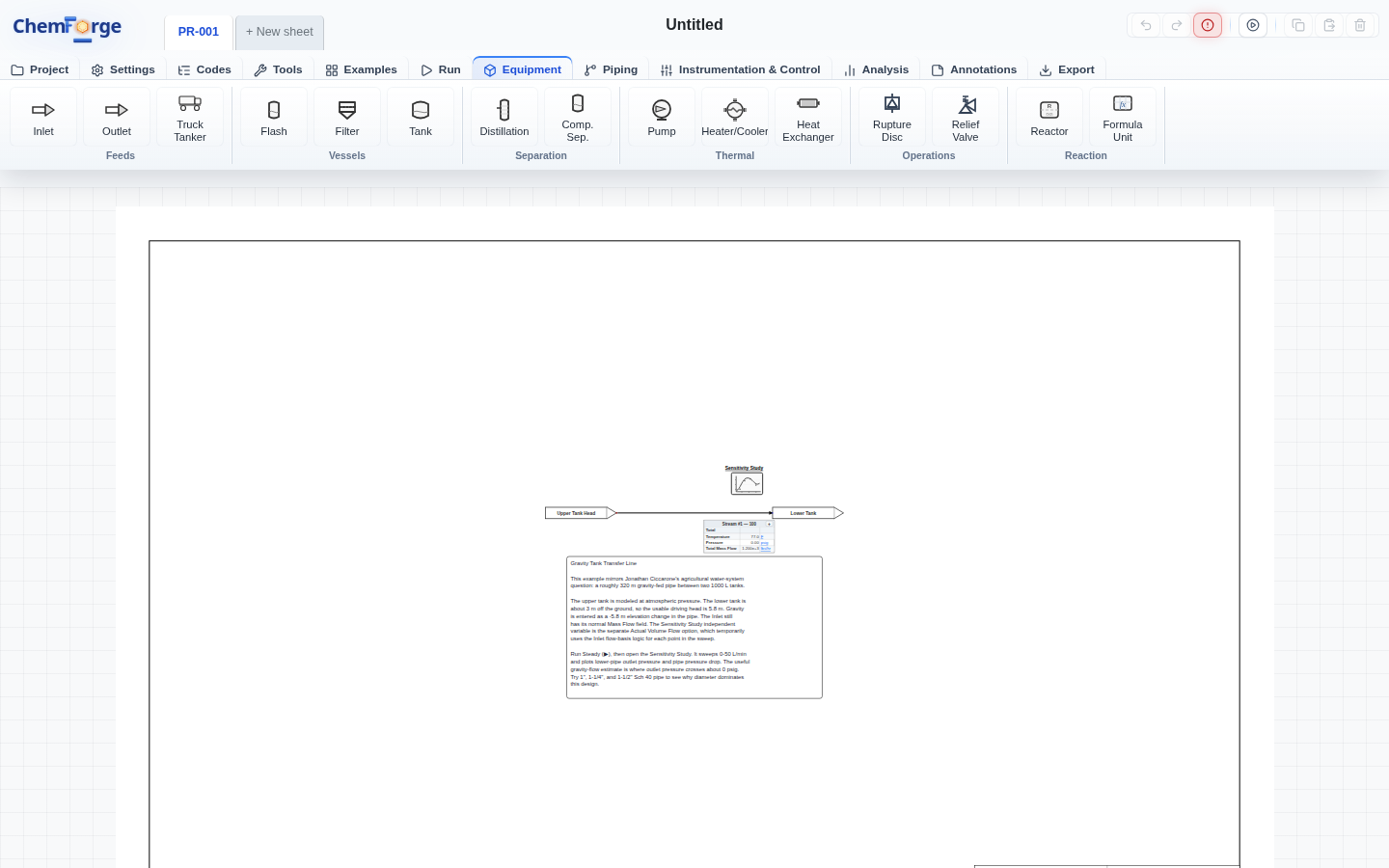
What's in the flowsheet
- An Inlet representing the upper tank at atmospheric pressure. Its normal Mass Flow field is left intact.
- A single connector pipe: 320 m long, smooth plastic roughness, 1" Sch 40 inside diameter as a close proxy for small PVC/HDPE tubing, a -5.8 m elevation change, plus one pipe-exit loss.
- An Outlet representing the lower tank connection.
- A Sensitivity Study using the separate Actual Volume Flow independent-variable option to sweep 0-50 L/min and plot pipeline outlet pressure and pipeline pressure drop.
What the sensitivity study says
The curve is the useful part: increase the requested flow until the pipeline outlet pressure reaches about 0 psig. Above that flow, the pipe would need more gravity head than the tanks provide.
| Model input | Value | Why it matters |
|---|---|---|
| Pipe length | 320 m | Long enough that friction dominates the answer. |
| Pipe size | 1" Sch 40 | Small diameter means high velocity and high head loss. |
| Elevation change | -5.8 m | The lower tank stand subtracts 3 m from the gross elevation. |
| Sweep range | 0-50 L/min | Shows the operating limit without manually guessing flows. |
What to try first
- Open the example and run the flowsheet.
- Open the Sensitivity Study and look at the XY Chart tab.
- Read the approximate flow where Pipeline Outlet Pressure crosses 0 psig.
- Change the connector pipe from 1" to 1-1/4" or 1-1/2" Sch 40 and rerun the study. The pressure curve shifts sharply because velocity falls with diameter.
How to read the result
A valve can reduce the flow rate because it adds resistance. It does not create more available elevation head; it moves the operating point to a lower flow where the pipe friction and valve loss fit inside the gravity head. For this kind of system, increasing pipe diameter is usually the cleanest way to keep useful flow without needing a pump.
ChemForge uses Darcy-Weisbach with a friction factor approximation to Colebrook-White, then adds fitting K-factors and any elevation term on the connector. This example keeps the inlet's Mass Flow field intact; the Sensitivity Study temporarily uses the inlet flow-basis logic to evaluate each L/min point in the sweep.
Open the flowsheet
Launches ChemForge with the gravity tank transfer line pre-loaded. Free, no sign-up.
Open in ChemForge